


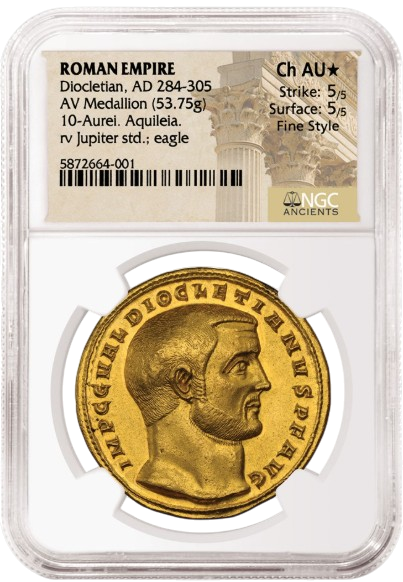
Not sure what the grades mean?
Take a minute to familiarize yourself with NGC’s Ancients Grading

Understanding Ancient Coin Grading (NGC Explained Simply)
Ancient coin grading is different from modern coin grading — and for good reason. Ancient coins were hand-struck, used in daily life, buried for centuries, and later recovered. No two examples are ever truly identical.
This page explains how ancient coins are graded by NGC, what those grades actually mean, and how collectors describe quality in the ancient coin market.
What Does “Grading” Mean for Ancient Coins?
Grading describes a coin’s state of preservation, but with ancient coins, preservation is only part of the story.
Rather than using the modern 1–70 numerical scale, NGC Ancients uses a descriptive (adjectival) grading system. This system focuses on:
How much actual wear a coin shows
How it was struck
How it survived over time
How well the design was engraved
Because ancient coins were handmade, a coin can appear soft or uneven without being worn. NGC accounts for this.

The Four Things NGC Evaluates
NGC does not judge ancient coins by a single number alone. Instead, every coin is evaluated across four separate components.
1. Grade (Wear Only)
The Grade measures circulation wear — how much detail has been lost from use in antiquity.
Common grades include:
Fair (F) – heavy wear
Very Fine (VF) – moderate wear with clear devices
Extremely Fine (XF) – light wear
About Uncirculated (AU) – trace wear
Mint State (MS) – no circulation wear
Important: Weak details caused by worn dies or a soft strike do not count as wear.
2. Strike (1–5 Scale)
The Strike score reflects how well the coin was made at the moment it was struck.
Rated from 1 (weak) to 5 (strong), Strike considers:
Centering of the design
Strength and evenness of the strike
Die wear or cracks
Planchet flaws
Overstriking or double strikes
A coin can have a high grade but a lower strike — or vice versa.
3. Surface (1–5 Scale)
The Surface score evaluates everything that happened after the coin was struck, excluding wear.
This includes:
Cleaning or smoothing
Scratches or marks
Porosity or corrosion
Encrustation
Patina quality (especially on bronze coins)
Burial and recovery effects
Ancient coins were often buried for hundreds or thousands of years. Surface issues are expected and evaluated accordingly.
4. Style
Ancient dies were hand-engraved, meaning artistic quality can vary greatly.
Coins with superior engraving and visual impact may receive:
Fine Style
Style is judged by comparing:
Quality of engraving
Balance and composition
Other coins from the same series
Ancient art from the same culture and period
Not every coin from a “fine style” die qualifies — strike and surface still matter.
Why Some Coins Grade Higher Than Expected
NGC grades wear accurately, even when details are missing.
If a coin lacks sharp detail due to:
Worn dies
Weak or uneven striking
…it may still receive a higher grade than expected, while the weakness is reflected in the Strike score instead.
This prevents unfairly penalizing coins for ancient manufacturing realities.
What Is a Net Grade?
A Net Grade is a single overall grade that accounts for all strengths and weaknesses together.
For example:
A lightly worn coin with rough surfaces may net to VF
A sharply struck coin with damage or poor surfaces may also net to VF
Net grading is commonly used for bulk submissions and reflects how a coin trades in the marketplace as a whole.
Market Quality Terms Used for Ancient Coins
In addition to formal grading, collectors and dealers often use quality tiers to describe overall desirability. These are market terms, not official NGC grades.
Promo / Entry
Heavy wear or surface issues
Historically interesting but low eye appeal
Affordable entry into ancient coins
Average
Typical example for the type
Honest wear and average strike
Most surviving ancient coins fall here
Select
Better-than-average eye appeal
Clear legends and devices
Popular with collectors
Premium
Strong visual impact
Above-average strike, surface, and style
Actively sought after
Excellent
Exceptional preservation for the type
Clean surfaces and strong strike
Near the upper end of known examples
MG (Mid Grade)
Balanced quality with solid detail
Strong collector value without extreme pricing
HG (High Grade)
Among the best preserved examples known
Minimal compromise in wear, strike, or surface
LG (Low Grade)
Heavily worn or damaged
Historically important but budget-friendly
How to Read an Ancient Coin Correctly
When evaluating an ancient coin:
Grade = how much it circulated
Strike = how well it was made
Surface = how it survived
Style = how well it was engraved
Together, these tell the full story.
Final Thought
Ancient coins are not modern products — they are survivors of history. Grading exists to explain their condition, not to demand perfection.
Understanding how grading works allows collectors to:
Buy with confidence
Compare coins fairly
Appreciate what makes each piece unique
If you ever have questions about a specific coin or grade, we’re always happy to help.